Showing posts with label Bill McKibben. Show all posts

Tuesday, August 23, 2011

We Shall Overcome

"Sir, step forward please."

A buff mustachioed officer of the DC Park Police motioned me to come closer. I'll never forget his next four words, "You are under arrest." He then told me to turn around and snapped thick plastic bands around my wrists.


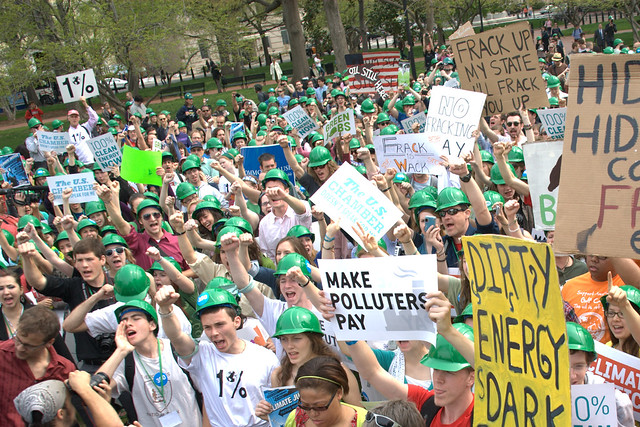
I was the third-to-last of 59 participants in civil disobedience earlier today to be arrested at the White House. We were taking nonviolent direct action in opposition to the proposed Keystone XL Pipeline, which would bring tar sands oil from Alberta, Canada to the US Gulf Coast. Aside from the danger this pipeline would pose to sources of drinking water, rural and indigenous peoples, and wildlife, if this carbon were to enter the atmosphere it would be game over for climate. Estimates place the tar sands contribution to CO2 concentrations in the atmosphere at 600 parts per million (ppm), so this pipeline is kind of a big deal. For reference, 350 ppm is the concentration at which human life on Earth developed. We're currently somewhere between 385 and 395 ppm CO2, and steadily climbing.


After each of us was pulled from the rest of group lined up along the sidewalk, we were led into a small tent and then loaded into a paddy wagon to be transported to the Anacostia branch of the Park Police for further processing. I was loaded into the last truck along with Jerome from New Jersey and Bishop from Virginia. To say we were cramped would be an understatement. Imagine bouncing around in the back of a mobile toaster. Then imagine having your hands behind your back, and you'll get a sense of our experience. I was first on the transport so I had a view out of the front of the vehicle through the metal mesh between myself and the driver. As we wove through the streets of DC behind our motorcycle escort past the White House, through the Mall beside the Washington Monument, and across the Anacostia River, I wondered what the tourists were thinking. What's all this ruckus? Who are these criminals being transported across town? I could see them turning their heads along the sidewalks as they heard the whine of the sirens coming down the street. I chuckled to myself. If only they knew that behind the windowless walls of the truck sat a recent college graduate, an environmental engineer, and a lawyer who'd all been demonstrating at the White House only moments before. We're doing this for you, I thought, and we're doing this for each other.

Processing once we arrived at the jailhouse was relatively painless. One by one they snapped off our plastic cuffs and led us to a long table staffed with officers who had us fill out paperwork for our release. Because of the low severity of our crime - we were charged with failure to obey a lawful order (aka get off the sidewalk) - and the benevolence of the Park Police, we were granted a "post and forfeit" release. Under these terms we could pay a $100 fine instead of staying overnight in jail and arranging a date in court. Thankfully we were instructed to have cash on us beforehand, and we were all out of police custody by 2:00 or so. Not so bad considering arrests had started around 11:30. I also want to make a point of saying that the DC Park Police were courteous and professional throughout the process, and I hope they spend my $100 wisely.

One of the most remarkable things for me about this action was the ability of a group of complete strangers to come together and rally around a common vision. It was even more astonishing to me that part of that goal was arrest. Action organizers affectionately used the phrase "risking arrest" when describing the action we were to take but after three previous days of arrested participants we had a good idea of what we were in for. The vast majority of us, like myself, were first-time participants in a demonstration of this kind and had never been arrested before. This could have made for a nervous bunch, but after spending several hours at a civil disobedience training session last night we were comfortable enough to put our trust in one another and take this leap of faith together. Leading up to the action I was anxious about entering into a scenario where I wasn't in control of my personal well-being (wait, you mean we're actually going to be arrested, like arrested arrested?), but as soon as I showed up at the White House this morning I knew that I would be in good hands - those of the wonderful, courageous, and passionate people who had come from all over the country to stand beside me. I realized too that sometimes you must relinquish that control in order to take control of something you care about.

One of the most memorable moments from today was when my buddy (we each had action buddies who were our go-to's for support throughout the day) Lawrence MacDonald and others led us in a variation of We Shall Overcome, an anthem of the Civil Rights movement. The lyrics drew nicely on the essence of what we were trying to accomplish.

We shall overcome, we shall overcome,
We shall overcome someday;
Deep in my heart, I do believe,
We shall overcome someday.

We'll walk hand in hand, we'll walk hand in hand,
We'll walk hand in hand someday;
Deep in my heart, I do believe,
We'll walk hand in hand someday.

We shall live in peace, we shall live in peace,
We shall live in peace someday;
Deep in my heart, I do believe,
We shall live in peace someday.

We shall heal the earth, we shall heal the earth,
We shall heal the earth someday;
Oh, deep in my heart, I do believe,
We shall heal the earth someday.

If today showed me anything, it's that this day is coming and we can get there even quicker if we work together to oppose injustice and bring positive change to the world.

Final note: Infinite thanks to the Tar Sands Action organizing team. Your help in preparing us for what we could expect throughout the day and your presence before, during, and after the action were invaluable to this experience. It honestly wouldn't have been possible, and won't continue to be possible this next week and a half, without your tireless work. I'm exhausted after participating in a single day, I can't imagine the resolve it must take to be out there day after day training a new group and seeing them safely through the arrest process. I think I speak for all of those who participated with me today when I say you are the real heroes of this action. Thank you!
Saturday, August 20, 2011

Stop the Tar Sands: Stand Tall Generation Y

This post originally appeared last week in a Daily Kos blogathon featuring responses to the proposed Keystone XL pipeline. If this were to be approved, the pipeline would bring tar sands oil from Canada to the US Gulf Coast and serve as the fuse to one of the largest carbon bombs on the planet. If we are to have any hope of mitigating the catastrophic consequences of climate change, this carbon must stay in the ground. Here's why I'm participating in civil disobedience against the Keystone XL this week.

I've always balked a little at the notion that we should take action on climate change for the sake of our children, and for our children's children. This idea rubs me the wrong way because it creates a temporal disconnect with the immediacy of these issues, reinforcing the misconception that climate change is something that isn't happening while giving those suspicious of doing good for the environment another reason not to care. That, and of course it's not true. We need to take action on climate to save ourselves too.

Whenever I hear someone reference future generations in relation to climate change I can't help but think, "They're talking about me. These adults are talking about me." See, I was born in the late nineteen eighties which means that if US life expectancy is anywhere near accurate I will still be alive well after 2050. To put it simply, if I don't take action on climate then I'm not only jeopardizing my branch of the family tree but my own existence entirely. I don't have the luxury of playing wait and see. None of us do. Of course I'm an adult too now and as we charge further into the 21st Century an idea that may be a vestige of environmental messages of old becomes less and less relevant as more climate-passionate young people join the cause and conversation.

Climate must be a priority now. Our current greenhouse gas trajectory exceeds even the worst-case fossil fuel intensive projections made in 2007 for emissions over the next 100 years. The following video depicts a message Bill McKibben articulated beautifully in a Washington Post op-ed in May: Connect the dots. The destructive consequences of a changing climate are happening all around us.


When I first heard about the two weeks of civil disobedience in Washington I thought this is an incredible and unique opportunity. Through our participation we can show the one man responsible for approving or rejecting the pipeline, President Barack Obama, that we mean business. The groundswell of support for this action and the satellite protests that have cropped up across the country for those who cannot make it to DC prove that we've grown tired of our leaders' inability to make significant progress on climate change. Oftentimes when I think about direct actions I can take to have a positive impact on the environment my mind wanders to behavior changes in my personal life. But participating in civil disobedience is a whole different animal, and for me a no-brainer. Let's get this country's attention and convince the Commander in Chief to stop one of the most destructive projects in discussion today.

I recently came across a passage of a speech Obama gave back in 2006. He said:
"The issue of climate change is one that we ignore at our own peril. There may still be disputes about exactly how much we're contributing to the warming of the earth's atmosphere and how much is naturally occurring, but what we can be scientifically certain of is that our continued use of fossil fuels is pushing us to a point of no return. And unless we free ourselves from a dependence on these fossil fuels and chart a new course on energy in this country, we are condemning future generations to global catastrophe."
Without a doubt President Obama has diverged from this message. Sure, he may not think he has enough remaining political capital to craft meaningful climate legislation, especially when current members of Congress advocate abolishing the EPA and recently rejected a measure that would have admitted the climate is changing and human activities are the cause. In the midst of such an obstructionist political setting it's up to us to show him he's not alone. Further action simply cannot wait. He needs to understand that approving the Keystone XL pipeline would be a direct affront to those who elected him.

Therefore this post is a call to all members of Generation Y to come out in strength and stand tall outside the White House starting this weekend. The votes of the 18- to 25-year-old demographic were essential to Obama's victory in 2008 and we need to hold him accountable. We’ve inherited quite the complex global problem and it’s up to us to solve it, or perish. We ARE the future generation we’ve heard so much about. The clock is ticking.

I remember in the very first announcement on Grist about the plans for the civil disobedience there was a portion which read: "We don’t want college-age kids to be the only cannon fodder in this fight.... Now it’s time for people who’ve spent their lives pouring carbon into the atmosphere (and whose careers won’t be as damaged by an arrest record) to step up too." Fellow Gen-Yers, will we get arrested? It's entirely possible. We're not supposed to stand still in the location where we'll be gathering outside the White House. But this space offers President Obama such a prime view of us we simply can't pass it up. Should we let the threat of tainting our personal records deter us from showing our support for this cause? Never. Would we want to work somewhere that couldn't understand and accept the type of thoughtful and principled action we'll be engaging in? I don't think so. I will be outside the White House a week from today, on Tuesday August 23rd, and I hope you will join me.

Monday, June 13, 2011

Watch this Video. Just Watch It.


Last year one of my professors warned my class not to associate extreme weather events with climate change, a point I explored in several posts that spring (See here, here, and here). In this video Stephen Thomson narrates Bill McKibben's Washington Post op-ed over images of these disasters and relevant political tidbits, creating an incredibly haunting and convincing portrait of recent events. At this point I'm not really sure what to think, but I'm now asking myself this question: If no one extreme weather event can be linked to climate change then at what point (if any) can a series of such catastrophes be attributed to a changing climate? And if this connection is made, can they even be called "natural" disasters anymore?

Monday, April 18, 2011

Power Shift 2011: Bill McKibben and Tim DeChristopher


Unfortunately I wasn't able to attend Power Shift this year, though the friends I've talked to about it have all said it was an incredible experience. Thankfully in the technology age I've been able to follow along with a lot of the action on Twitter (which has officially displaced Facebook as my social media outlet of choice; follow @agmaynard). During my internet explorations I came across two videos of speeches that I think are worth sharing. The first is Bill McKibben, author and the founder of 350.org. The second is Tim DeChristopher, a climate activist who was in the news recently for crashing a federal auction and bidding nearly $1.8 million for oil and gas leases he had no intention of paying for.

Let's listen to McKibben first:


McKibben speaks about corrupt politics in Washington, and how we can't let dirty money (largely from the Chamber of Commerce and the industrious Koch bothers, pun intended) win out in the end. He says building a movement that is louder and more impassioned than the opposition will be the key to achieving the significant policy victories necessary to prevent catastrophic changes to the climate system. We've already caused 1 degree of warming (that's Celsius, by the way) and if we get to 5 or more we're cooked. It's up to us to make sure that doesn't happen in the next hundred years or so.

Some highlights:
  • They [politicians] believe that because they can amend the tax laws they can amend the laws of nature too, but they can't. (on Congress voting to deny anthropogenic climate change).
  • The first thing we need to do is build a movement. We will never have as much money as the oil companies so we need a different currency to work in. We need bodies, we need creativity, we need spirit. 350.org has been like a beta test for that movement.
  • We need to fight with art and with music too, not just with the side of our brain that likes bar graphs and pie charts but all our heart and all our soul.
  • We need to speak with one loud voice.
Now let's listen to DeChristopher. Pay attention to how his tone is different than McKibben's:


DeChristopher's portrait of the future is far more dark than McKibben's. He speaks of the challenges we'll face and the sacrifices that must be made. Because the carbon we've already emitted into the atmosphere is there to stay, we are on track for the collapse of modern civilization. The greatest challenge moving forward will not be reducing emissions, but maintaining our humanity through the troubles to come. He also describes why events like Power Shift do little to prevent this from happening. "There's a lot of stuff about this movement that feels really good and that's really convenient but it's not preparing us for the challenge that we will face ahead of us," says DeChristopher. Of the problems we'll inherit he says, "We're not going to meet it in a convenient way. We're not going to meet it in a way that fits into our school schedules. We're not going to meet it in a way that we can avoid sacrifices." Without using these exact words he says this is war.

Through their speeches I think McKibben and DeChristopher describe different means to the same end. Both use the term civil disobedience, but I don't know if McKibben would support the types of interference his counterpart does (after all, DeChristopher is likely facing 5-10 years in prison for the gas lease auction bids). McKibben advocates for the "movement," for using the political capital built through organizations like 350 to influence policymakers in Washington. DeChristopher on the other hand advocates direct action, picketing at mountaintop removal sites for example. What's interesting about this suggestion is it would probably work and wouldn't end in a prison sentence (at least I'd hope not). But how many of you would actually travel to West Virginia and engage in this type of protest?

There is a palpable tension between what we need to do and what we are willing to do to solve the crisis of our generation. After listening to these perspectives one after another I find myself asking, "How far would I go to bring about the positive change we need?"

Sunday, September 5, 2010

Bill McKibben on Letterman

Last week environmental activist Bill McKibben appeared on the Late Show with David Letterman to discuss everything from the science of climate change and the obstructive power of the oil, coal, and gas lobbies, to China's rapid economic expansion and our political logjams in the United States, to the genesis of 350.org and the upcoming 10/10/10 Global Work Party.

Enjoy:


After the clip cuts out, there are another 30 seconds or so of dialogue, continued below.

Letterman: "But is what you're talking about adaptability really rather than correcting any of this?

McKibben: "You can adapt, maybe, to one or two degrees. You can't adapt to four or five degrees, so we've got to do both."

Letterman: "Special hats. Have you thought about special hats?"

McKibben: "There you go. Those'll help."

Letterman: "That's where my money is, ladies and gentlemen, special hats. Well Bill, thank you for just scaring the crap out of me."

Saturday, March 6, 2010

Is Too Much Evidence Delaying Action on Climate Change? Climate Skeptics and the OJ Simpson Trial

Have you been frustrated or perplexed lately by how effective global warming skeptics have been at casting doubt on the mountain of evidence that suggests the climate is changing? How about the fact that they are getting away with it? If so, I have an article for you.

In a recent op-ed on Mother Jones, 350.org co-founder and Middlebury College Professor Bill McKibben compares increased confusion about climate change to the OJ Simpson trial, i.e. where a preponderance of evidence wasn't enough to let justice be served.

McKibben says, "Without hard evidence to support their claims, climate denialists are attacking the process of climate-change science." The skeptics' search for the error in the integrity or validity of climate research is like looking for a needle in a haystack. But a bigger haystack means the potential for more needles.

McKibben also stresses how we can't rely on straight science to solve this issue for us, and we need to become more politically savvy in order to convince the American public that this is something they should be concerned about. "Science may be what we know about the world, but politics is how we feel about the world," he says, "And feelings count at least as much as knowledge."

Since McKibben is far more eloquent and well-versed on this issue than I am, I am going to let him do the rest of the talking. Read his full article here. Seriously, click on the link. It's one of the best pieces I've read in recent weeks. I promise you won't be disappointed.

Friday, October 23, 2009

McKibben's Challenge: When Good Politics are Bad Science


On the eve of what he says will be the "single most widespread day of political action the planet has ever seen," 350.org Co-Founder and Director Bill McKibben has written an op-ed in the Boston Globe challenging President Obama to answer the call to action (see post below or click here for background on 350.org's International Day of Climate Action).

McKibben argues that climate change is different than any problem we have faced before, and that Obama's strategy of "working with Congress to pass something modest" simply will not work. Climate change defies conventional political paradigms:

The negotiation that really counts is not between Republicans and Democrats or industry and the greens, or even between the United States and China. The real bargaining is happening between human beings and physics and chemistry, and that’s a tough negotiation.

Mother Nature has drawn a line in the sand: 350 ppm is the highest acceptable concentration of carbon dioxide in the atmosphere. There is no negotiating. There is no compromise.

In order to meet this goal, we must demand more serious climate action from our legislators and our Commander in Chief (McKibben says, "The bill making its way through Congress explicitly aims for a world with 450 parts per million carbon."). If Obama is worried he will exhaust his political capital by throwing his weight behind stricter climate legislation while dealing with health care reform and the struggling economy, he must look no further than the 4594 events planned in 175 countries this Saturday. With such widespread support from the global community, how could he afford not to promote bold policies?

McKibben concludes his piece in the Globe with the following challenge to our President:

It would risk real political capital to push for change on the scale that the science demands. Since even a politician of his talents can’t amend the laws of nature, though, let’s hope that beginning today he’s willing to take some real risks.

Obama is scheduled to give a speech on "American leadership in clean energy" at MIT in the morning to promote the Senate climate bill. Let's listen carefully to what he says and decide if he lives up to McKibben's challenge or if he reverts back to conventional political practices.

(Image above courtesy of the Boston Globe)

Sunday, October 18, 2009

350.org International Day of Climate Action


One number will determine the fate of our planet. 350 parts per million is the atmospheric concentration of carbon dioxide above which the earth can no longer naturally sequester (absorb) the greenhouse gas and climate change occurs. 350.org, a nonprofit organization focused on raising awareness about this essential benchmark, is creating an international movement to pressure political leaders to agree to adopt strong climate legislation at the UN Climate Change Conference in Copenhagen in December.


In a recent post on Treehugger.com, 350.org Co-founder and Director Bill McKibben describes the significance of the 350 limit and also outlines the challenges we face in order to meet it:

It's as if we suddenly discovered what normal body temperature was, so we'd be able to tell when we were running a fever. In that sense, it came as a great relief.


But in every other sense, it was a pretty devastating number. For one thing, we're already past it, at 390 ppm and rising two ppm annually--that's why the Arctic is melting. For another thing, it means the work nations and individuals must do to reduce their carbon footprints is much larger, and must happen much more swiftly, than we'd believed. Hansen's data [Jim Hansen and his team of NASA researchers established the 350 metric] shows that as a planet we'd need to get off coal by 2030 in order for the planet's forests and oceans ever to bring atmospheric levels back down below 350--that's the toughest economic and political challenge the earth has ever faced.


The time to hesitate, to doubt, and to second-guess has passed. We now have a quantifiable metric for the success of our environmental efforts, and it's going to take a hell of a lot of collaboration and innovation to meet it before the effects of climate change become irreversible.


This Saturday, October 24th, 350.org is hosting a global call to action to mobilize members of the international community. So far there are 3,769 events planned in 163 countries. By demonstrating to our respective governments that there is definite support for climate legislation, we pressure them to act boldly in Copenhagen. The following video captures the essence of the event:


To find a 350 rally near you, or to start your own if there isn't one already, click here.

We have an immense amount of work to do and a desperately short amount of time to do it. If we are to ever succeed in this endeavor, we are going to need everyone's help. We need to send a clear message to our political leaders that we won't accept anything less than a commitment to carbon legislation in Copenhagen that respects the 350 ppm limit. Let's get out there on Saturday and make our voices heard.