Wednesday, May 11, 2011

Exxon, For Shame

In the past week I've seen the following Exxon commercial probably a dozen times. You may have seen it too, or one like it. They usually include a charismatic narrator describing how some aspect of Exxon's operation is valuable to our country. You can almost hear them pleading, "We're doing the right thing, don't you see?" But this most recent commercial, part of their 2011 corporate ad program, really rubbed me the wrong way. Why? Because it's a blatant lie. Brilliant marketing, and a blatant lie.

Watch:


Geologist Erik Oswald touts the benefits of natural gas exploration. "Technology has made it possible to safely unlock this cleaner burning natural gas," he boasts, "These deposits can provide us with fuel for 100 years, providing energy security and economic growth all across this country." All the while, the background video displays expanses of wilderness, sleepy households, and mom-and-pop shops on Main Street opening for business (complete with American flags, of course. Hurrah for exploiting patriotism).

If Mr. Oswald were telling the truth, this commercial would go a little something like this: "Extremely toxic and unregulated technology has made it possible for us to extract natural gas right in your backyard. Natural gas produces about 30 percent less carbon dioxide than petroleum, so sure it's more efficient but it's still a dirty fuel." Smiling sheepishly, he'd continue, "These deposits can provide us with fuel for 100 years which is really no time at all, perpetuating our addiction to fossil fuels. It would lead to economic growth for those that have rigged the system to reap the benefits. Heck, Exxon enjoyed record profits during Q1 in 2011! For others, those we exploit, natural gas exploration will lead to extreme human health risks and contaminated drinking water. But who cares about them?"

Sorry Mr. Oswald, but in the words of Michael Scott, "Boom, roasted."

It is precisely what is not mentioned in this commercial that is so troubling. The unspoken phrase here is hydraulic fracturing, even though that is exactly the type of natural gas exploration and extraction that it describes. For those of you who aren't familiar with the technique, hydraulic fracturing (also known as fracking) involves injecting a toxic cocktail of chemicals thousands of feet beneath the earth's surface to break up porous rock and release the natural gas trapped within. But of course the term "fracking" isn't used, because it's a dirty word (pun intended).

One of the reasons I'm so worked up about this commercial is two weeks ago I saw Gasland. After receiving a $100,000 offer for a gas lease on his land in Pennsylvania, filmmaker Jeff Fox decided to investigate fracking sites across the country and made this award-winning documentary. What he found could not be more contradictory to the natural gas utopia depicted by Oswald and Exxon.

Watch the Gasland trailer to get a sense of what I'm talking about:


I'm unsure if any film has ever affected me the way Gasland did. I came out of the screening irate and upset. How could something so clearly dangerous and untested be allowed? I wanted to throw these images and these stories in the faces of those who continually deny a link between fracking and environmental and human health crises. I think that's why it moved me so much - because this just wasn't a story about environmental degradation on a national scale. It was also a narrative about the destruction the social fabric of the families and the communities that now can't fish in their waterways, let their kids play outside, or trust the air they breathe in their own homes.

I think watching this movie had the same effect on me that reading Cormac McCarthy's The Road did last year, even though the cause of the dying earth he vividly depicted was never explicitly stated to be environmentally rooted. The anger I feel towards this Exxon commercial reminds me of the fear I felt after reading that book. But what role do these emotions play in the climate movement? I think we shy away from the realities of climate change because what's happening to the planet is so immense in scale and complexity, and we need to remain hopeful and happy to pull us through. But these emotions are valuable in their own right, not to mention entirely justified. And this brings us to the central problem with this commercial - Exxon expects us to accept it hook, line, and sinker. I say, "How dare they?" They don't fool me and they shouldn't fool you either. The next time you see this commercial or one like it, understand it for what it is.

In the last 24 hours I've signed this Change.org petition asking Mr. Oswald to halt fracking activities and one from 350.org asking Congress to end subsidies to oil companies. I urge you to do the same.

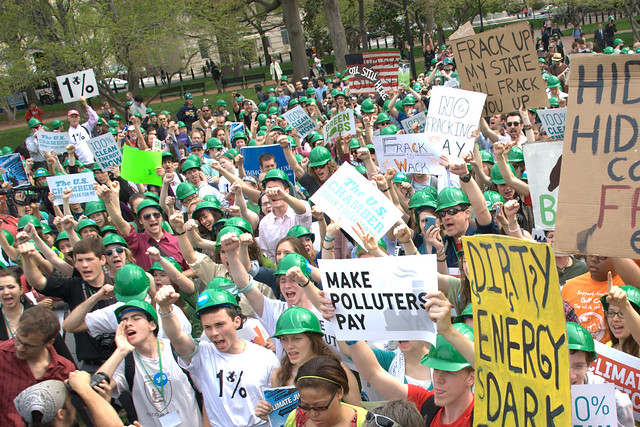
Image credit: "What the Frack?" by Option-G.
Friday, April 29, 2011

Barcelona, 1908

Sometimes it's hard to imagine a time when automobiles didn't rule the road. The following video gives us a glimpse into the streets of Barcelona one hundred years ago when there were no cars, only streetcars:


It's almost impossible to envision a major modern city without cars (okay I'll come clean, there are a few of the first automobiles in this clip). One of the coolest things about this video though, is that without cars everyone uses the street. There are more pedestrians in the street than on the sidewalk. Bicycles weave back and forth across the streetcar-mounted camera. There are few carriages and even fewer automobiles. The video commentary from Pattern Cities echoes the importance of this idea:

This incredible film... demonstrates the degree to which modern society has engineered complexity out of our streets. It also provides a glimpse into how our city streets operated before the automobile went mainstream, a seminal 20th century moment that has damaged cities the world over.

But surely the streets of the 1900s were not entirely crash-free, or as romantic as this film and its whimsical music make them out to be. Yet, the inherent complexity– the organized chaos of streetcars, pedestrians, horse-drawn carriages, and yes, motorists all mixing together–is instructive and should make any urbanist long for a time when the tyranny of the automobile didn’t dominate the project of city building.

Unfortunately I don't think we will ever return to the ideal displayed here. We've traveled too far along our current path. Effectively merging cars and cities is not an easy task, but it is something that is an important problem in the 21st Century. Throughout the discussion around the impacts of automobile use on the planet I am amused by those who wish to do away with them entirely. Aside from being unfeasible - we've developed a modern transportation network predicated on automobility - it's also unfavorable. There's a reason cars are so popular. Car owners love the autonomy inherent in being able to go where you want to, when you want to. I'm not foolish enough to suppose that nothing will ever replace the automobile (where is my jetpack, anyhow?) but I am certain they are here to stay for the foreseeable future. And yes, maybe even through the 100 year timeline often cited as the window of opportunity to improve the odds on climate change. Since altering the infrastructure that mandates automobile use will take longer than we realistically have time for, the answer could depend on the speed at which we improve efficiency of hybrid vehicles and develop better electric vehicle technology. That said, we could sure do ourselves a favor and make fewer decisions like this one.

Monday, April 18, 2011

Power Shift 2011: Bill McKibben and Tim DeChristopher


Unfortunately I wasn't able to attend Power Shift this year, though the friends I've talked to about it have all said it was an incredible experience. Thankfully in the technology age I've been able to follow along with a lot of the action on Twitter (which has officially displaced Facebook as my social media outlet of choice; follow @agmaynard). During my internet explorations I came across two videos of speeches that I think are worth sharing. The first is Bill McKibben, author and the founder of 350.org. The second is Tim DeChristopher, a climate activist who was in the news recently for crashing a federal auction and bidding nearly $1.8 million for oil and gas leases he had no intention of paying for.

Let's listen to McKibben first:


McKibben speaks about corrupt politics in Washington, and how we can't let dirty money (largely from the Chamber of Commerce and the industrious Koch bothers, pun intended) win out in the end. He says building a movement that is louder and more impassioned than the opposition will be the key to achieving the significant policy victories necessary to prevent catastrophic changes to the climate system. We've already caused 1 degree of warming (that's Celsius, by the way) and if we get to 5 or more we're cooked. It's up to us to make sure that doesn't happen in the next hundred years or so.

Some highlights:
  • They [politicians] believe that because they can amend the tax laws they can amend the laws of nature too, but they can't. (on Congress voting to deny anthropogenic climate change).
  • The first thing we need to do is build a movement. We will never have as much money as the oil companies so we need a different currency to work in. We need bodies, we need creativity, we need spirit. 350.org has been like a beta test for that movement.
  • We need to fight with art and with music too, not just with the side of our brain that likes bar graphs and pie charts but all our heart and all our soul.
  • We need to speak with one loud voice.
Now let's listen to DeChristopher. Pay attention to how his tone is different than McKibben's:


DeChristopher's portrait of the future is far more dark than McKibben's. He speaks of the challenges we'll face and the sacrifices that must be made. Because the carbon we've already emitted into the atmosphere is there to stay, we are on track for the collapse of modern civilization. The greatest challenge moving forward will not be reducing emissions, but maintaining our humanity through the troubles to come. He also describes why events like Power Shift do little to prevent this from happening. "There's a lot of stuff about this movement that feels really good and that's really convenient but it's not preparing us for the challenge that we will face ahead of us," says DeChristopher. Of the problems we'll inherit he says, "We're not going to meet it in a convenient way. We're not going to meet it in a way that fits into our school schedules. We're not going to meet it in a way that we can avoid sacrifices." Without using these exact words he says this is war.

Through their speeches I think McKibben and DeChristopher describe different means to the same end. Both use the term civil disobedience, but I don't know if McKibben would support the types of interference his counterpart does (after all, DeChristopher is likely facing 5-10 years in prison for the gas lease auction bids). McKibben advocates for the "movement," for using the political capital built through organizations like 350 to influence policymakers in Washington. DeChristopher on the other hand advocates direct action, picketing at mountaintop removal sites for example. What's interesting about this suggestion is it would probably work and wouldn't end in a prison sentence (at least I'd hope not). But how many of you would actually travel to West Virginia and engage in this type of protest?

There is a palpable tension between what we need to do and what we are willing to do to solve the crisis of our generation. After listening to these perspectives one after another I find myself asking, "How far would I go to bring about the positive change we need?"

Monday, April 4, 2011

Ghost Cities


This really freaks me out (and it should freak you out too). Reporters from Australian TV show Dateline explore the empty streets of Dongguan to document the dark reality of China's real estate boom. Six years after its opening, the "New" South China Mall remains 99 percent vacant. Government development agencies raze single-story tenements to make way for high-rise apartments that few Chinese can afford. But construction continues.

Admittedly one of the reasons I find this tour of Dongguan so spooky is because of the visual parallels I draw to one of my favorite movies, Serenity. In the scene below, the crew of the Firefly discovers a secret the centralized Alliance government was determined to keep hidden. They stumble upon the planet Miranda and find it completely deserted, with no evidence of war, famine, or other catastrophe.


My favorite quote from this clip (besides "She is starting to damage my calm") is when Jayne says, "She's right. Everybody's dead. This whole world is dead for no reason." Now let me ask you something: Decomposing bodies and government population-calming experiments aside, is Dongguan any less "dead" than Miranda? Can a city exist without the people who inhabit it?

Not only are the views of an empty Dongguan (and the pop-culture references they suggest) unnerving in and of themselves, but the implications of all of that real estate sitting vacant for years is equally alarming. I'm not familiar enough with Chinese property development trends to say what this means for China's economy, but real estate analyst Gillem Tulloch asserts that it is experiencing a property bubble like we've never seen before, one "that will make the United States pale in comparison." We all know how that turned out, don't we?

Despite the warnings and the precedents, this type of development continues. In this Grist.org piece about the video, Sarah Goodyear writes: "And yet around the globe, governments and business interests continue to build projects like these.... They should look more closely at the Chinese example -- beyond the GDP numbers to the bricks-and-mortar reality. Because when economic growth is pursued for its own sake, without regard to the needs and capabilities of the humans inside that economy, it is only a matter of time before the bubble will burst."

Monday, March 21, 2011

BMW: Activate the Future


Each Tuesday throughout the month of February, BMW released one segment of a four-part documentary entitled Wherever You Want to Go. The film covers topics including how the changing shape of our cities will determine how we move through them, what we can learn from airplanes and astronauts, and how keeping mobility fun is essential to transforming our transportation system. Commentators include Lawrence Burns, author of "Reinventing the Automobile," Robin Chase, Founder of Zipcar, and astronaut Buzz Aldrin. Watch the documentary below (all four parts together are about 25 minutes long).

Part 1: The New City


Part 2: The Future Just Isn't What it Used to Be


Part 3: Reinventing Mobility


Part 4: How We'll Learn to Stop Worrying and Love the Future


For more information about the film, visit the BWM Documentaries website.